

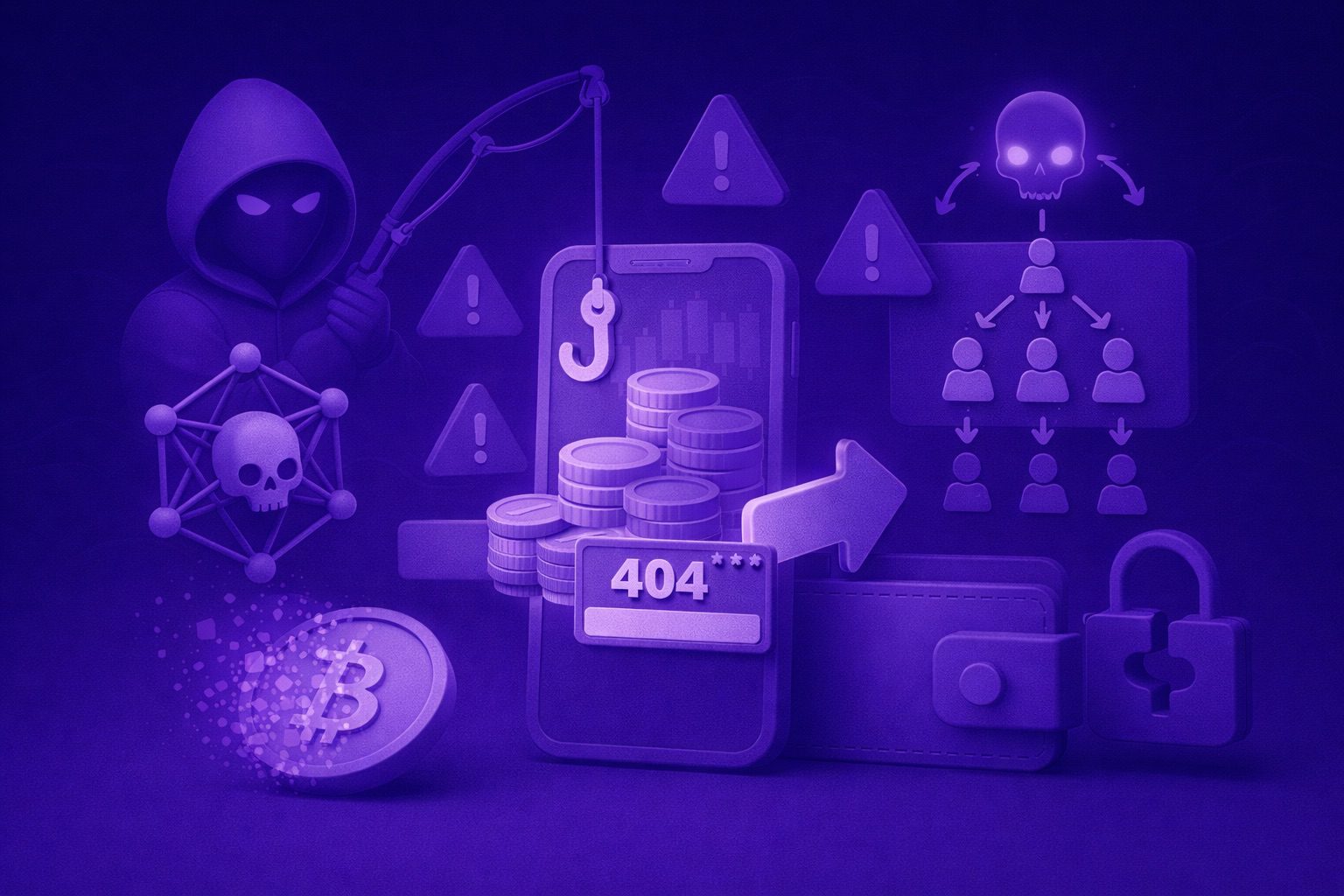
Cryptocurrency attracts not only investors, but also scammers. According to the FBI, victims of crypto scams in the United States alone lost $9.3 billion in 2024 — a 66% increase compared to the previous year. The average loss per victim reached $10,000, while for people over 60 it exceeded $30,000.
This article is a practical guide to the most widespread crypto fraud schemes. We break down five of the most dangerous ones: pig butchering (long-term manipulation through «friendship» or «romance»), phishing and crypto drainers (theft via fake websites), rug pulls (when project founders disappear with investors’ money), fake exchanges and Ponzi schemes, and support impersonation scams. At the end, you’ll find universal safety rules and a clear action plan if you’ve already been targeted.
Pig Butchering — «Fattening the Pig»
Pig butchering is the most profitable scam for criminals, accounting for roughly one-third of all crypto-related losses. The term comes from China (杀猪盘 — literally «pig slaughter») and perfectly describes the process: the victim is first «fattened» with trust, then «slaughtered» — all their money is taken.
How the scam works
It usually starts innocently. A stranger messages you — on Telegram, WhatsApp, a dating app, or even via an SMS claiming they «dialed the wrong number». A conversation begins. The person appears successful, interesting, and sometimes attractive.
Building trust takes weeks or even months. The scammer communicates daily, shares «personal» stories, and shows genuine interest in your life. Sometimes it feels like a romantic relationship, other times like a friendship with a financially successful person.
Eventually, your new contact casually mentions how well they’re doing with cryptocurrency. They show screenshots of profits and offer to «teach» you, directing you to a «trusted» platform. You invest a small amount — say, $500. The platform shows steady growth. You may even be allowed to withdraw part of the funds to make everything look legitimate.
Encouraged by this success, you invest more: $5,000, $20,000, sometimes life savings or borrowed money. When you try to withdraw a large amount, the platform suddenly demands a «tax», «fee», or «verification payment». After you pay, there’s another charge — and then another. Soon after, the scammer disappears, the platform goes offline, and your money is gone.
Real-world cases
An 82-year-old man from the US, Dennis Jones, met a woman named Jessie on Facebook. Over time, she convinced him to invest in cryptocurrency. Dennis invested all his savings. One day, Jessie vanished — along with his money.
An even more dramatic case involved the collapse of Heartland Tri-State Bank in Kansas. The bank’s CEO himself became a victim of a pig butchering scam. Trying to «recover» supposedly frozen funds, he misappropriated $47 million from the bank. The bank went bankrupt, and the CEO was sentenced to 24 years in prison.
How to spot and avoid pig butchering scams
Red flags to watch for:
- A stranger initiates contact and pushes for constant communication.
- The person seems «too perfect» — successful, attractive, overly understanding.
- They avoid video calls or in-person meetings, always with excuses.
- They steer conversations toward crypto or investments.
- They recommend a «trusted» platform you’ve never heard of.
- They pressure you to act quickly («limited offer», «once-in-a-lifetime opportunity»).
The rule is simple: never invest based on advice from someone you don’t know personally. If an «online friend» starts talking about crypto investments, it’s almost certainly a scam. Legitimate investment opportunities do not arrive via unsolicited private messages.

Phishing and Crypto Drainers
In 2024, crypto drainers emptied wallets worth $494 million. These are malicious scripts that automatically drain all assets from your wallet after you connect it to a fake website.
What is a wallet drainer?
A drainer (literally «one that drains») is malicious code embedded into a scam website. When you connect your crypto wallet (such as MetaMask, Trust Wallet, and others) and sign a transaction, the script gains permission to withdraw your funds.
The key danger is that you give this permission yourself — you just don’t realize what you’re signing. The transaction may look like «airdrop participation confirmation» or «wallet verification». There is even a full-fledged «drainer-as-a-service» industry: scammers buy ready-made tools for $300–900 and launch their own scam campaigns.
Fake websites and scam airdrops
An airdrop is a free token distribution by a crypto project. Scammers create fake airdrops to lure victims.
You see an airdrop announcement — on Telegram, X (formerly Twitter), through Google ads, or even from a hacked account of a well-known project. You click the link and land on a website that looks legitimate (the address differs by just one letter or uses a different domain). You connect your wallet to «claim» the tokens, sign a transaction — and the drainer instantly empties your wallet.
Fake airdrops related to the Hamster Kombat project affected millions of Telegram users. Scammers also cloned the Wall Street Pepe website — victims lost all their assets within seconds. One single tool, Inferno Drainer, was used to steal over $80 million via fake airdrops.
Another common tactic involves «bait tokens»: an unknown token suddenly appears in your wallet. You visit a website to investigate or try to sell it — and end up interacting with a drainer.
How to protect your wallet
Before connecting to a website:
- Check the URL carefully — scammers use lookalike domains (for example, uniswаp.com instead of uniswap.org).
- Look for official links only on verified project channels (official X account, Discord).
- Never click links from ads or private messages.
When signing transactions:
- Always read exactly what you’re signing.
- If you see «approve unlimited» or unclear permissions, reject the transaction.
- Use a separate «hot» wallet with a small balance for new or unfamiliar websites.
Enable phishing protection in MetaMask and other wallets. Regularly review and revoke unnecessary permissions using services like Revoke.cash. And never interact with unknown tokens that suddenly appear in your wallet — they may be bait.
Rug Pull — «Pulling the Rug»
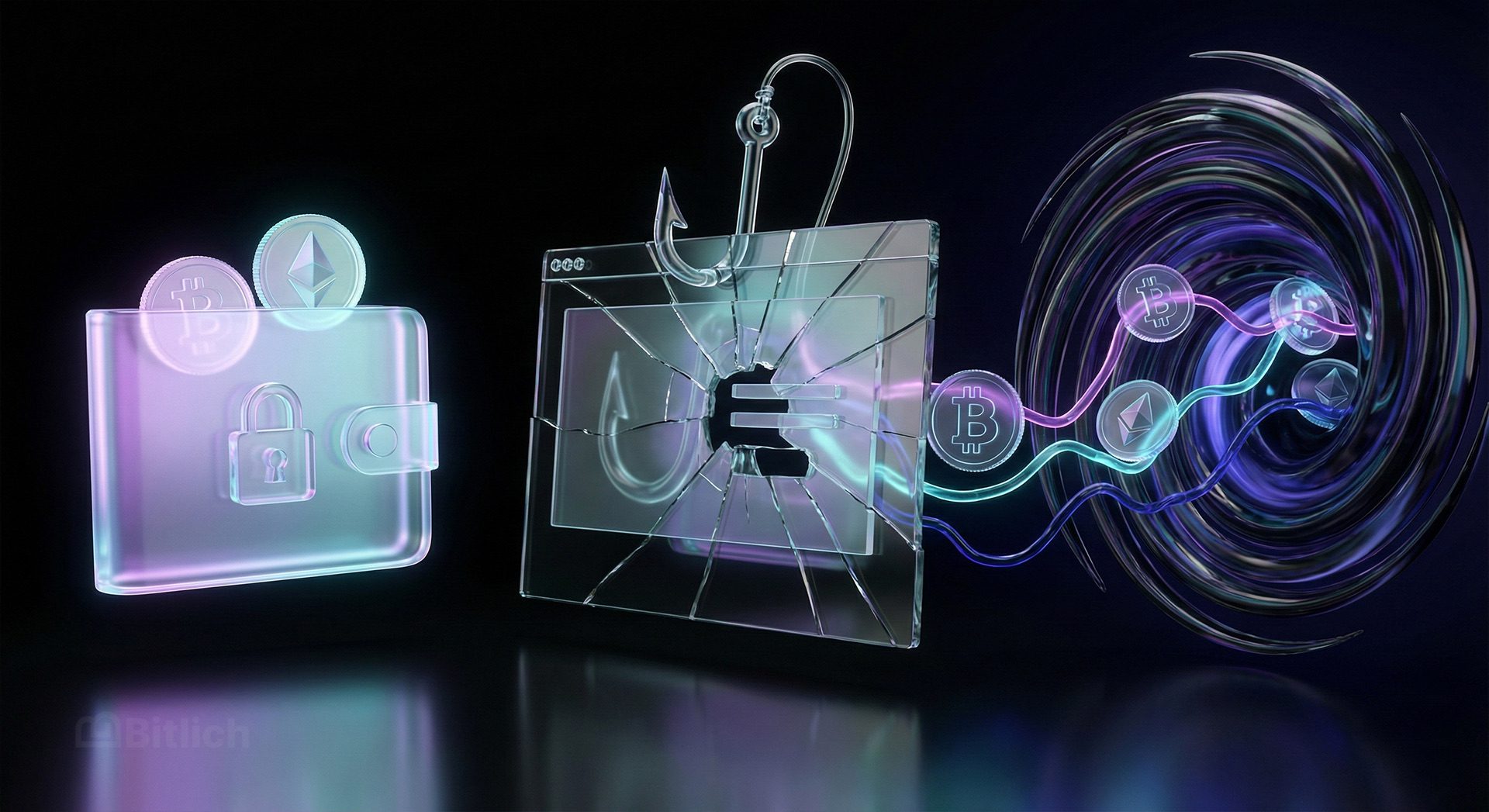
A rug pull happens when the creators of a crypto project suddenly take all investor funds and disappear — literally «pulling the rug out from under» investors. In early 2025, losses from rug pulls reached nearly $6 billion, even though the total number of incidents declined. Scammers simply started operating on a much larger scale.
What it looks like in practice
A new token appears with loud promises: a revolutionary technology, partnerships with well-known companies, guaranteed growth. Aggressive marketing follows — across social media, Telegram channels, and influencer promotions. The price rises, early buyers show off profits, and hype builds rapidly.
Once enough money is raised, the developers withdraw all liquidity from the pool. The token’s value collapses to near zero within minutes. Selling becomes impossible.
A notable example is Kokomo Finance, a DeFi protocol on the Optimism network. The developers initially deployed legitimate code, later replaced it with malicious logic, and drained $5.5 million. The website and social media accounts were removed almost instantly. An even larger case involved the Turkish exchange Thodex: its founder fled with $2 billion in user funds and was later sentenced to 11,196 years in prison.
Why memecoins are especially risky
In 2025, most rug pulls were linked to memecoins. These tokens can be created in minutes without any real product. People buy them purely on hype, without researching the project. Low liquidity makes price manipulation easy, while FOMO («fear of missing out») shuts down critical thinking.
According to research data, 98.6% of tokens launched on Pump.fun on the Solana network turned out to be rug pulls or pump-and-dump schemes.
Signs of a potential rug pull
Technical red flags:
- The token can only be bought, not sold — a classic «honeypot».
- Developers control a large share of the token supply.
- The smart contract has not been audited, or the audit is from an unknown firm.
- Liquidity is not locked.
Marketing red flags:
- Aggressive promotion promising «1000x» returns.
- Anonymous teams or fake developer profiles.
- Inflated social media followers with obvious bot activity.
- Pressure tactics like «buy now or miss out».
- No real product or clear roadmap.
- A whitepaper copied from other projects.

Fake Exchanges and Investment Platforms
Scammers create websites that look exactly like legitimate crypto exchanges. You sign up, deposit funds, and see «profits» on the screen — but those numbers are fake. In reality, withdrawals are impossible.
Crypto Ponzi schemes
Cryptocurrency has become a perfect wrapper for Ponzi schemes. Complex terminology confuses beginners, «decentralization» creates a false sense of security, and transactions are difficult to trace and nearly impossible to reverse.
These platforms promise high, fixed returns — 10–15% per month or even per week. Early investors do receive payouts, funded by money from new participants. This creates social proof («my friend already made money»). Once the flow of new funds dries up, the scheme collapses.
HyperFund, a Ponzi scheme disguised as a crypto mining company, caused an estimated $1.7 billion in losses. Its founders were charged by the U.S. Securities and Exchange Commission.
In another case, the Adams brothers in the US promised 13.5% monthly returns using a «trading bot», raised $60 million, and spent the money on luxury goods.
In 2025, the CBEX platform collapsed, leaving investors across several African countries with losses totaling millions of dollars.
How to check a platform before investing
Essential checks:
- Regulation — legitimate exchanges are licensed and supervised by recognized regulators (such as the SEC, FCA, or EU national authorities).
- Track record — how long the platform has been operating and whether it’s mentioned by reputable media outlets.
- Reviews — look for feedback on independent platforms, not on the company’s own website.
- Realism — guaranteed returns of 10%+ per month are a major red flag.
- Transparency — a real company address, contact details, and a registered legal entity.
Stick to large, well-established exchanges such as Binance, Bybit, Kraken, and Coinbase.
Never trust platforms «recommended» by strangers online. Start with small amounts and always test withdrawals before committing larger sums.

Support Impersonation and Fund Recovery Scams
These schemes are especially cynical: scammers target people who have already lost money or are dealing with an ongoing issue.
Fake exchange support
You post about a problem with an exchange or wallet on X (formerly Twitter) or Telegram. Soon, a «support agent» replies — the account looks official, with a logo and a nearly identical name. They ask for information to «resolve the issue»: your seed phrase, private key, or they request that you connect your wallet to a «verification service». Once access is granted, the scammer drains all your funds.
Remember: legitimate support teams never initiate private messages. No real service will ever ask for your seed phrase or private key. Official support operates through ticket systems on the company’s website — not via social media DMs.
«We’ll get your money back» — the recovery scam
After becoming a victim of fraud, many people start looking for ways to recover their funds. This often leads to a «recovery scam» — a second layer of fraud.
A so-called «crypto recovery company» finds victims through ads, social media, or direct outreach (often using leaked databases). They promise to recover stolen funds for a fee or a percentage of the amount. Victims pay upfront — and the scammers disappear. In other cases, they demand «taxes» or «fees» to unlock supposedly recovered assets.
The reality is harsh: recovering stolen cryptocurrency is almost always impossible. Crypto transactions are irreversible. Legitimate investigation firms such as Chainalysis and Elliptic work with law enforcement agencies, not directly with private individuals. Anyone who guarantees fund recovery is a scammer.

How to Protect Yourself — Universal Rules
Regardless of the type of scam, there are basic security principles everyone should follow.
Protect your seed phrase and private keys
- Never share your seed phrase — with anyone, ever. Not with «support», not with «developers», and not with «friends from the internet».
- Store your seed phrase offline — on paper or a metal backup, never in phone notes or cloud storage.
- Use separate wallets: a cold wallet for long-term storage and a hot wallet with a small balance for daily activity.
Verify information before acting
- Don’t trust recommendations from strangers — whether «experts» on Telegram or «friends» from social media.
- Access exchange websites via bookmarks or direct search (skipping ads), not through links in messages.
- Research any project before investing: team background, audits, history, and independent reviews.
Practice good financial hygiene
- Invest only what you can afford to lose.
- If an offer sounds too good to be true, it’s a scam.
- Don’t give in to FOMO or pressure tactics like «act now».
Enable two-factor authentication (2FA) wherever possible. Use a separate email address for crypto accounts. Regularly review wallet permissions and revoke anything you no longer need.
What to Do If You Become a Victim
If you suspect you’ve been scammed:
- Stop all payments immediately. Do not send «additional fees» or «taxes to unlock funds» — these are part of the scam.
- Secure your access. If you shared account credentials, change passwords immediately. If you connected your wallet to a suspicious website, create a new wallet and move any remaining assets.
- Collect evidence. Save conversations, screenshots, wallet addresses, and transaction hashes.
- Report the incident. File a report with local law enforcement and contact the exchange you used to send funds — in some cases, funds can be frozen on the recipient’s side.
- Ignore recovery offers. Companies promising to recover crypto for an upfront fee are running a second scam.
Frequently Asked Questions
Can stolen cryptocurrency be recovered?
In most cases, no. Crypto transactions are irreversible. Sometimes law enforcement manages to trace and freeze funds on exchanges, but this is the exception rather than the rule. Companies that promise to recover cryptocurrency in exchange for an upfront fee are scammers themselves.
How can I tell a real airdrop from a fake one?
A legitimate airdrop is announced only through a project’s official channels (a verified X (formerly Twitter) account, an official Discord server). It never asks for your seed phrase, upfront payments, or wallet connections to unknown websites. If someone messages you privately offering «free tokens», it’s a scam.
Why do scammers use cryptocurrency?
Crypto transactions are pseudonymous (it’s difficult to identify the recipient), irreversible (payments can’t be undone), and global (scammers can operate from anywhere). This makes cryptocurrency an attractive tool for criminals and significantly complicates enforcement efforts.
Which exchanges are safe to use?
Relatively safer options are large, well-established exchanges with licenses and a long track record, such as Binance, Bybit, Kraken, Coinbase, and OKX. That said, even on regulated exchanges you must follow basic security practices: enable two-factor authentication, use a unique password, and be cautious when connecting to third-party services.
What should I do if a stranger messages me about crypto investments?
Ignore and block them. This is a classic starting point for pig butchering scams. Legitimate investment opportunities do not arrive via unsolicited private messages from strangers. No matter how convincing or friendly the person seems — if they start talking about crypto investments, it’s a scam.
Conclusion
Cryptocurrency offers financial freedom, but it also demands personal responsibility. Unlike a bank, there is no «undo» button and no support desk that can reverse a fraudulent transaction.
The core rule is simple: if something sounds too good to be true, it isn’t true. There are no guaranteed high returns, no exclusive opportunities from strangers, and no «secret» platforms.
Healthy skepticism is your strongest defense. Spending an extra 10 minutes verifying information can save you all your money.



wonderful issues altogether, you just won a logo new reader. What would you suggest in regards to your submit that you made a few days in the past? Any certain?